
Iranian President Claims 7 Hour Meeting With Mojtaba Khamenei, Says Supreme Leader Is ‘Completely Healthy’
· 71 views
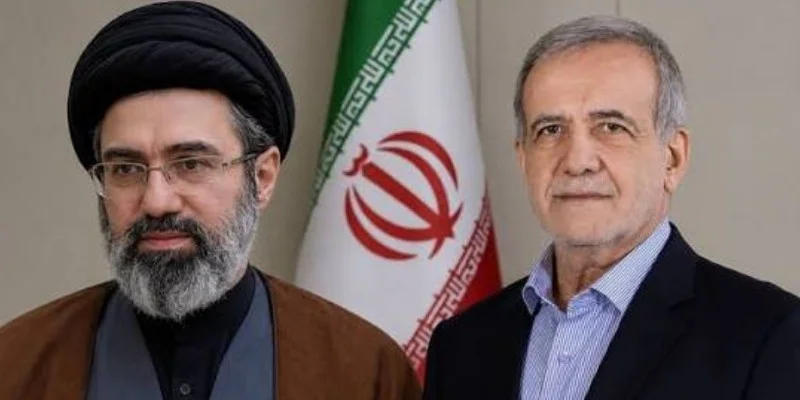
Washington/Tehran (Terror Monitor) — Iranian President Masoud Pezeshkian has claimed that he held a nearly seven-hour meeting with Supreme Leader Mojtaba Khamenei, during which they discussed Iran’s political, economic and security situation, as conflicting reports continue to circulate about the supreme leader’s health.
Speaking to Iran’s state broadcaster IRIB, Pezeshkian said the meeting focused on the economic situation of the Iranian people, employment, housing, sanctions, the government and public response to the current situation, as well as maintaining national unity and solidarity.
According to Pezeshkian, Mojtaba Khamenei emphasized the need to preserve unity and warned that Iran’s enemies were focused on creating divisions and discord inside the country.
Pezeshkian also claimed that Mojtaba Khamenei was “completely healthy” physically during the meeting.
The meeting was first reported by the Supreme Leader’s official website.
Mojtaba Khamenei has remained largely absent from public view since assuming the position of Supreme Leader. No verified public audio or video of him has been released, while, apart from Pezeshkian, no other senior Iranian official has publicly described a face-to-face meeting with him.
Pezeshkian had previously said on May 6 that he had held a meeting with Mojtaba Khamenei lasting approximately two and a half hours.
Major Changes in Iran’s Military Leadership
The latest report on the meeting comes as Mojtaba Khamenei’s official website has published a series of orders announcing major changes in Iran’s military and security leadership.
According to the published orders, Ali Abdollahi, commander of the Khatam al-Anbiya Central Headquarters, has been appointed chief of the Iranian Armed Forces. He replaces Abdolrahim Mousavi, who was killed in U.S. and Israeli attacks.
The order said one of Abdollahi’s key responsibilities would be to integrate the armed forces under the Khatam al-Anbiya Central Headquarters.
In another order, Kiomars Heydari was appointed deputy chief of the armed forces. He had previously served as deputy commander of the Khatam al-Anbiya Central Headquarters.
Ahmad Vahidi was also appointed commander of the Islamic Revolutionary Guard Corps. According to the information provided, former Supreme Leader Ali Khamenei had appointed Vahidi to the position in January.
Mostafa Izadi was appointed deputy commander of the IRGC.
Separately, Mostafa Taeb was appointed commander of the Basij force, replacing Gholamreza Soleimani, who was killed in U.S. and Israeli attacks. Taeb had previously served as Basij commander.
The appointments represent a significant reshaping of Iran’s senior military and security leadership amid continuing regional tensions.
Conflicting Reports Over Mojtaba Khamenei’s Health
Pezeshkian’s claim that Mojtaba Khamenei was physically healthy comes days after Iranian and international media published reports raising serious questions about his condition.
IranWire, citing two sources described as being close to the administration of President Pezeshkian, reported that Mojtaba Khamenei was in extremely critical condition and could die at any time.
Reuters separately reported, citing three sources, that Mojtaba Khamenei had suffered serious injuries in an attack on the Supreme Leader’s compound in Tehran on February 28.
The attack reportedly killed his father, former Supreme Leader Ayatollah Ali Khamenei.
According to information attributed to Reuters sources, Mojtaba Khamenei suffered severe facial injuries and serious injuries to one or both legs.
Reports in Iranian media also claimed that his daughter, son-in-law and granddaughter were killed in U.S. and Israeli attacks.
However, the reported details of Mojtaba Khamenei’s current medical condition, the extent of his injuries and claims concerning his possible death have not been independently verified.
The Iranian government has not officially confirmed reports that he is in critical condition or facing imminent death.
Continued Absence From Public View
Mojtaba Khamenei’s prolonged absence from public view has fueled speculation about his health.
Reports say he has not appeared publicly since becoming Supreme Leader, and no independently verified video or audio recording of him has been released. Publicly available communications attributed to him have largely consisted of written statements and official orders.
Reuters reported that despite his reported injuries, Mojtaba Khamenei has continued to play a role behind the scenes in major government affairs and has communicated with senior officials through audio contacts.
There is, however, no detailed official information available about his physical condition or daily activities.
Absence From His Father’s Funeral
Mojtaba Khamenei’s absence was also notable during the funeral and final rites of his father, Ayatollah Ali Khamenei.
According to reports, Mojtaba did not attend his father’s funeral, while his brothers Mostafa, Meysam and Masoud were present.
His absence further fueled speculation about his health. Iranian officials, however, attributed his nonattendance at the time to security concerns. His absence therefore cannot by itself be regarded as conclusive evidence of a medical condition.
IranWire Report Raises Further Questions
In its latest report, IranWire cited two sources described as close to the Pezeshkian administration as saying that Mojtaba Khamenei’s condition was extremely serious and that his death could occur at any time.
The report did not provide specific details about a particular illness or his current medical condition.
IranWire said his prolonged absence had also raised questions within Iranian political circles about his health, activities and role in decision-making.
Mojtaba Khamenei’s Rise to Supreme Leadership
Mojtaba Khamenei assumed Iran’s Supreme Leadership following the death of his father, Ayatollah Ali Khamenei.
According to the information provided, the Assembly of Experts appointed him in March 2026 after an interim council had temporarily exercised the powers of the Supreme Leader.
The leadership transition occurred amid intense regional tensions and a wartime environment. After decades of rule under Ali Khamenei, Mojtaba Khamenei faces the challenge of maintaining political, military and security continuity while dealing with major domestic and regional pressures.
The recent appointments of senior military and security officials are being viewed as part of the restructuring of Iran’s leadership under the new Supreme Leader.
No Official Confirmation of Critical Condition
Despite multiple reports concerning Mojtaba Khamenei’s health, the Iranian government has not officially confirmed claims that he suffered severe facial or leg injuries, is in critical condition or may have died.
Likewise, the medical information reported by IranWire and Reuters remains attributed to sources and has not been independently verified in full.
In contrast, President Masoud Pezeshkian has now offered a markedly different account, saying that he met Mojtaba Khamenei for nearly seven hours and that the Supreme Leader was physically “completely healthy.”
The conflicting accounts have intensified questions surrounding Mojtaba Khamenei’s health and public absence.
Until Iranian authorities provide clearer and independently verifiable information, claims about his medical condition should be treated as reports attributed to sources rather than established facts.
Related Articles
Israel Intensifies Airstrikes on Southern Lebanon, Killing at Least 11
At least 11 people, including two children and two medical workers, were killed in Israeli strikes on southern Lebanon, as Israel intensified its air campaign despite a June ceasefire with Hezbollah. The latest attacks have raised renewed concerns over the future of the ceasefire and stability along the Lebanese-Israeli border.
More Than 140 Killed in Clashes Between Yemen’s Government Forces and Houthis
More than 140 fighters have been killed in recent clashes between Yemen’s government forces and Iran-aligned Houthi fighters in southwestern Yemen. The fighting over the strategic Bab al-Mandab Strait has become the deadliest in the area in two months, with more than 300 fighters and some civilians reportedly killed since Thursday.
Israel Strikes Hezbollah Positions in Southern Lebanon
Israel says it struck multiple sites in southern Lebanon in response to two Hezbollah drone attacks targeting Israeli soldiers. The Israeli military also warned residents near a building in Arab Salim to evacuate, saying Hezbollah was using the site. Hezbollah has not commented.
Russian Missile Strike in Ukraine Kills Five Steel Plant Workers
A Russian ballistic missile strike on a steel plant in Ukraine’s eastern Dnipro region has killed five workers and damaged production facilities and other infrastructure. Steelmaker Metinvest said all operations at the plant had been suspended following the attack.